
SRA and AXA RESTful Interface User Guide

Introduction
The Farsight Security Advanced Exchange Access (AXA) RESTful Interface adds a streaming HTTP interface on top of the AXA toolkit https://github.com/farsightsec/axa to enable developers of web-based applications to interface with Farsight Security's SIE Remote Access (SRA) and Realtime Anomaly Detector (RAD) servers.
The SRA module facilitates the real time streaming of data from theSecurity Information Exchange (SIE) over HTTP using a RESTful API.
Access is controlled via an API key that is passed as the X-API-Key HTTPheader.
Audience
This user guide is written for:
- Programmers who want to write applications that interact with the Python module or the RESTful API
- System Engineers comfortable using command line tools
Requirements
Operating System
The Farsight Security AXA RESTful Interface does not have any specificoperating system requirements as it is delivered over a RESTful API.Farsight Security provides a convenience command line interface (CLI)tool that doubles as a Python 2.7 extension module which is compatiblewith various modern operating systems.
Hardware
Minimum hardware requirements to get started with Domain Sentry are asfollows:
- 1 CPU
- 1 GB Memory
- 1 GB Disk
Note: Depending on the amount of data you end up processing, you mayneed to increase the resources accordingly.
Network
AXA REST requires HTTPS permitted outbound to axamd.sie-remote.net.
Service Entitlement
Subscribers must have purchased a service entitlement from FarsightSecurity and have been provisioned an API key.
Delivery Options
The SRA module is delivered by Farsight Security AXA RESTful Interface.Farsight Security has created some additional tools that utilize theRESTful API:
- Python Package
axamd_clienta Python module and CLI tool created as a reference implementation and demonstration tool - REST API - the core mechanism to deliver the SRA module
Python Package: axamd_client
axamd_client is a reference implementation leveraging the AXA RESTful API. It is both a fully functional CLI tool and a Python 2.7 extension module. The primary purpose is of the CLI tool is to offer simplified access to SRA. Messages are emitted as newline-delimited JSON blobs which can be fed into any JSON-aware tools (such as jq https://stedolan.github.io/jq) for further processing.
Installation Instructions
These instructions assume a currently supported *inx operating systemwith Python 2.7.x installed.
- Download the software from the
axamd_clientGitHub Page
$ wget https://github.com/farsightsec/axamd_client/archive/debian/1.2.0.tar.gz
- Extract the software from the archive
$ tar xzvf 1.2.0.tar.gz
- Change directory
$ cd axamd_client-debian-1.2.0/
- Install prerequisites
$ sudo apt-get install python-setuptools
- Install the
axamd_clientpackage
$ sudo python setup.py install
- Create and configure your
.conffile
$ vi ~/.axamd-client.conf
- Copy and paste the following and specify your API key
apikey:
server: https://axamd.sie-remote.net
- Test the client by running with the
--list-channelsoption. You should see (at least)ch255listed
$ axamd_client --server https://axamd.sie-remote.net/ --list-channels
ch255:
      10.32.255.255/8430 10.32.255.255/9430
Additional documentation can be found on the Github repository for axamd_client https://github.com/farsightsec/axamd_client in the README https://github.com/farsightsec/axamd_client/blob/master/README.md file.
SRA Internals
The SRA module facilitates the real time streaming of data from the SIEover HTTP using a RESTful API.
Channels
SRA requires the user to specify one or more SIE channels to stream.These are specified as an integer, for example 255.
Watches
SRA requires the user to specify one or more IP watches and/or one ormore DNS watches. These tell the server what to filter and send to theclient. These are specified as ip={/CIDR} or-dns=example.com, or dns=*.example.com.
Example: --watches ip=192.253.0.0/16 dns=\*.example.com
The AXAMD Protocol
AXAMD is a server program that sits in front of SRA and RAD servers inside the Farsight Security, Inc cloud and serves requests from client browsers and custom programs over a RESTful API. The overall architecture is shown in Figure 1. AXAMD speaks REST to web-enabled clients and the binary AXA protocol to the SRA and RAD servers.
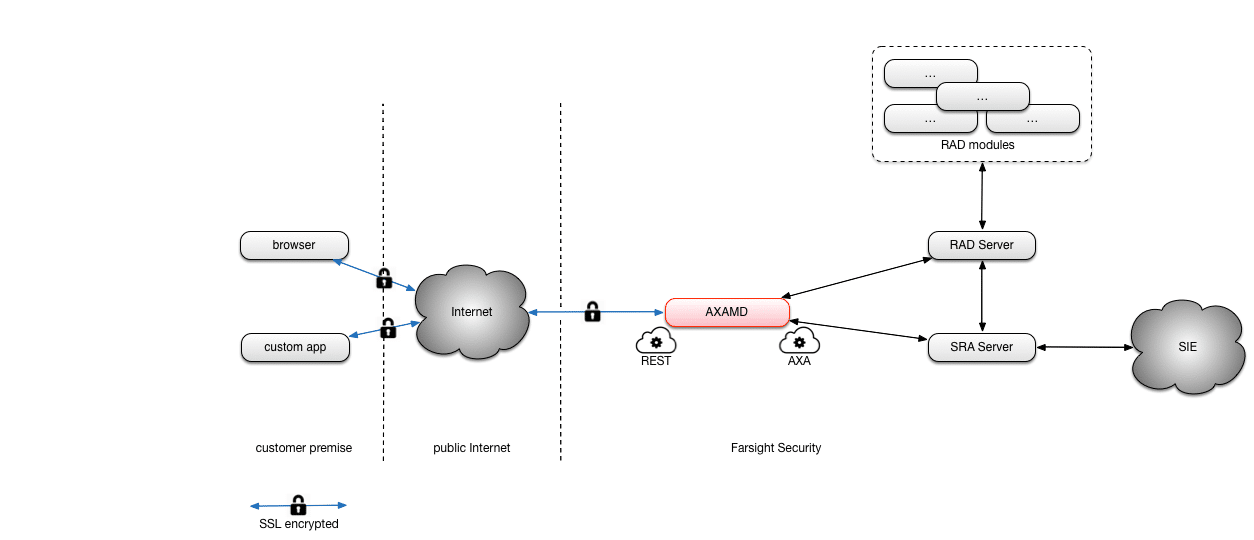
AXAMD is a stateful proxy enabling authorized users access SRA and RAD using a web browseror custom REST client.
AXAMD can be accessed via https://axamd.sie-remote.net.
REST API
The following details the REST API provided by AXAMD.
Server Type Specification
The server type will be specified as a URL path element, after the version. It will be srafor requests made to an SRA server and rad for requests made to a RAD server.
Authentication
Authentication is done via X-API-Key headers (as per DNSDB).
Content Negotiation
The client will specify the content type it wants via an Accept-Encoding request header.The following content-types will be made available:
- axa-json: This is the default. Watch hit metadata will be emitted along with the base64 encoded NMSG or IP packet that caused the watch hit.
- nmsg-presentation: Presentation format of NMSG that caused the watch hit (see nmsgtool -).
- nmsg-json: JSON representation of NMSG that caused the watch hit.
- nmsg-binary: Binary NMSG only that caused the watch hit (requires the addition of an input_http module to nmsg for the last one).
HTTP Response Codes
The following HTTP responses codes can be returned from API requests.
HTTP Response CodeMeaningDiscussion200Successful operation400Invalid parametersClient specified invalid channel, watch, or anomaly parameters401Missing or invalid X-API-Key402Out of RAD PointsClient tried to load a RAD module that would result in a negative balance403Not authorized for resourceClient tried to access a channel, watch, or anomaly without proper permission404Nonexistent resourceClient tried to access a channel, watch, or anomaly that doesn't exist500Internal Server ErrorSomething egregious happened server-side
Get Channel List
Returns JSON map of available channels, their statuses, and their descriptions
GET https://axamd.sie-remote.net/v1/sra/channels
Get Anomaly List
Returns JSON map of available RAD modules, their statuses, supported watch types, options
GET /v1/sra/anomalies
Post Data
POST /v1/sra/stream {
channels: [], watches: [str], anomalies: [{‘module’: str, ‘watches': [str],
    ‘options’: {str: str}}], rate_limit: int,
}
Channels is a list of channel names that should be enabled watch format has no tag on itanomalies is list of maps. map MUST contain module, may contain list of watches, mappingof option names to values rate_limit is optional.
Server auto assigns tags to watches and anomaly watches based on list indexes.
Sample Usage
axamd_client
Example usage of the axamd_client:
Steam all messages from the SIE heartbeat channel 255
$ axamd_client --server https://axamd.sie-remote.net/ --channel 255 --watches ch=255
REST API
Example usage of the REST API:
Steam all messages from the SIE heartbeat channel 255
curl --data '{ "channels": [255], "watches": ["ch=255"] }' \
    --header 'X-API-Key: abcdefgh-abcd-abcd-abcd-abcdefghijkl' \
    https://axamd.sie-remote.net/v1/sra/stream
Accounting Messages
By default, axamd will return AXA accounting messages containing currentcounter statistics relevant to your current session. For more details onthese packet counts, reference Farsight's Advanced Exchange AccessInternals: Understanding Accounting.
Limitations
The Farsight Security AXA RESTful Interface is not a recommendedsolution for SIE channels with an average data rate over 1 Mbps.